Enough


7:51 pm, May 30, 2026


8:45 pm, May 14

8:47 pm, May 14


Evenings and water. Datura that bloom for the moon. Petals twisting. The love of a pit viper for itself, for its young, for spaces even away from the water like this one in the woods. 

When I consider such things, I cannot help but hang on the idea that these are meaningful. And a life full of meaningful things is enough. Don't let me ask for a Meaning to life. Don't let me perseverate on Purpose. 

The feeling that This is enough is another way of saying Happiness. Or Gratefulness. Wellbeing.  It's the humility to want no more. The wisdom to quit. The strength to keep going because Enough is hope for today.

When all those who were my Beloved die and my grief does not know what to do with the happiness we once had, I can rest--as they rest in peace--knowing that their goodness, their life, our time together was enough. If I can feel it, then I can live in a boundless happiness. Enough knows no boundaries. But I keep forgetting this.

Right now it's about bedtime. I sit by the garden fence and listen to insects and owls through the hot night air. A tomato plant holds up its tender green branches in this still night. I could almost cry it is so sweet, so meek, so brave, so alive, so involved in doing the One thing and not more. What this living plant does for itself is enough. If it were anything else, it would not be a tender green plant still, in the dark. And what I share of it--this is Enough if I am really present in the I-Thou relationship between it and me.

All the wisdom traditions gesture in their folly toward what is Enough. The Stoics and the Epicurians and Thoreau and Jesus and the monastic Hindus, Buddhists, and Trappists. The whirling Sufi needs nothing but the dizziness of his love for the Beloved. The Taoists especially know what is Enough in the uncarved block. They might remind us that anything more than Enough throws us out of balance.

Cease craving.

Be still and know that I am God, he said.

I shall not want.

Enough.


"Enough of This"

some say Meaning is so big so golden

almost out of reach

others say there is none and all is dark

I say there is enough of this

just as I do not depend upon you

I need you as we love anything we love

no more justifications

no waiting for ends to give us our reasons

this morning’s kingfisher rising out of the creek or

the meadow of white stones 

after last summer’s flood or

the tall grasses holding sunlight

as we do when we stop and close our eyes

each we love and

each is itself the object of a moment of ours

meaningful without excuse or end

we and the kingfishers soon will die but

that is tomorrow and

tomorrow cannot be the reason for today

for this morning’s tall grasses

for this love for you

just as no measurement can find

the meaning for us of stones or the tall grasses

so with our love and any single meaningful thing

what, the smooth riverstone is not a mountain?

what, a bird is not a god?

what, our love is not more than it is?

you standing there brushing your teeth after a bath

me in the next room watching

you brush your teeth after a bath

the kingfisher rising out of waters

stones grass this morning

when we stop and close our eyes

it is enough

our finite size and time is enough

all the meaning we find or create is enough

love

Inoculation


[This post accidentally got left behind a bit more than a year ago. But here it is anyway.]


Inoculation


When the weight of nature’s gravity turns brutal,

I find surest relief by walking close to nature,

returning soon to home, now a healed being.


Nature deals death, disease, and the 

multitude of sufferings when our 

work contends with our world’s rawest rules.

Rain seeps inside, scoffing at our invented walls—

half a lifetime’s investments dissolve or rot—

tossed back outside now to 

crumble under summer’s sun.

Or we watch helplessly, empty hands dangling

at our side as nature’s own double helix

takes a twist for the worst.

Honest purchase damned by entropy’s 

casual indifference. Rust’s quiet appetite.


Everything’s breaking or broken.

Our things and ourselves dissolve and are forgotten

because of our mother-earth’s infanticidal apathy.

Yet I do not die before my death if, if that is, 

I practice seeing….

Practice feeling….

The wind by dawn, red and yellow snake-scale,

sun across waters, angles of leaf-vein

one after the other, feathers on the wing

drying outstretched above a marsh,

stone’s swirled patterns, fossils in the cliff,

wasp-wing, springs seeping out of the cutbank,

fiddleheads, cloud, darkening woods wet and 

dripping after a late-day rain.


You know what I’m saying.

Like the congregation that prays for comfort

from the god of hurricane and lightening strike, and

the diseases of mother’s children, 

I still find refuge in the guilty arms of nature.


But there’s also a vaccine made from the poison: 

spending whole mornings in a field, inoculating

ourselves from the next death or disease in line.

I cannot recall a walk through field’s-air or

wood’s-air that did not find my return home

a happier, stronger, less fearful way.

Yet to avert disaster, prevent unnecessary hurt?

We injected bits of smallpox to prevent

the blinding blisters later. Now a

morning walk introduces tame bits of a wild universe—

falling moon, frost on a dead fawn’s eyes,

reddened clouds high above—

soon the new day, 

hand of grace, the one that grips.


This is how the opposite side of the canyon returns evening light. The Creek (this blog is supposed to be about a creek) flows left to right just in front of the white sycamore trees in the middle. We call this "night rise," as the evening shadow rises up the canyon wall. As opposed to sun-set.


An Inca dove that had flown into one of our home's window. We quickly set it in a box in case it recovered from the traumatic brain injury (as more than half of the do). But this one died.  


At my funeral, let them think nothing more than dried grasses. 


Sheep


A sweet little mano
(a stone that's been ground down by Archaic campers along this Creek about three millennia ago)


Ago


A few years ago we began to wonder more and more about the history of this little Canyon through which flows Hamilton Creek and into which we had moved our life. We built a home, imported sheep and chickens, burried irrigation pipe, and pulled waters from the Creek out onto lean, sandy soils to coax a few vegetables, some berries, some tree fruits, and enough grass for lambs to grow to butcher-size. 

But who else had lived along these waters? Hungry immigrants from Tennessee and Kentucky, indefatigable ranchers like Samuel Holland, restless Mormons, Noah Smithwick, soot-faced cedar choppers, Civilian Conservation Corp laborers, and a neighbor or two losing their demented minds on land where they had been born and barefoot raised. 

And before them? Tonkawa and others chased by Apache. All of them chased by Comanche. The Comanche chased by their hollow dream of riding their horses into some victorious future. And before them, Spanish looters crazed by religion and greed. 

And before them....? The more we studied history, the more we were led back into pre-history. And pre-history is buried in our sand and clay if not scattered across barren hilltops. So we set to digging. 


A spear point freshly exposed to sunlight. After a long time.

The atlatl dart point (below) is from the Texas Middle Archaic (ca. 6300 to 4500 years ago), and the Bulverde and Montell points date from the Late Archaic (ca. 4500 to 1250 years ago). The site where we're excavating contains mostly Late Archaic artifacts, with a few that are younger or older.

Travis

Bulverde 

Montell


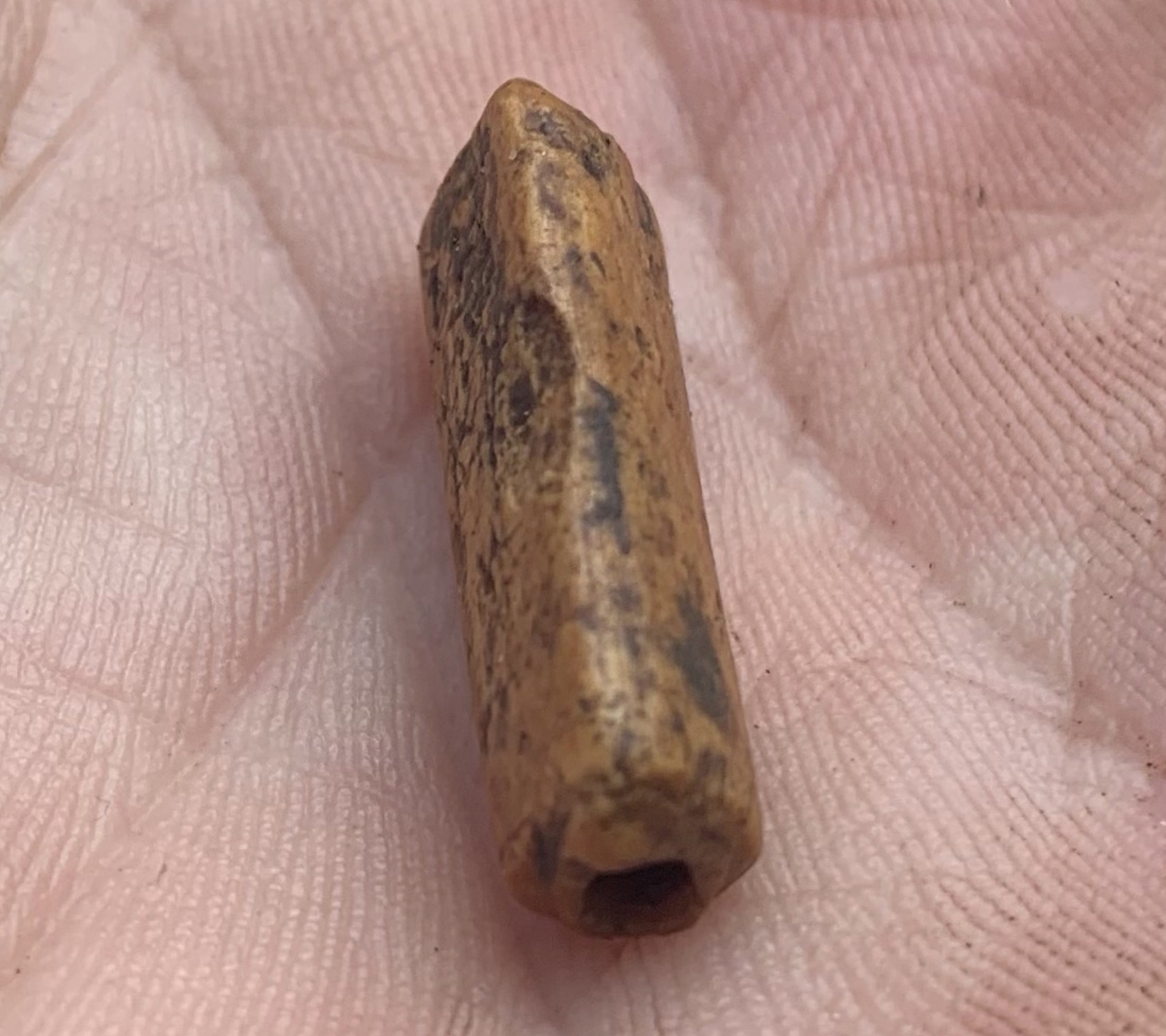
Bone bead

A chert perforator, or drill


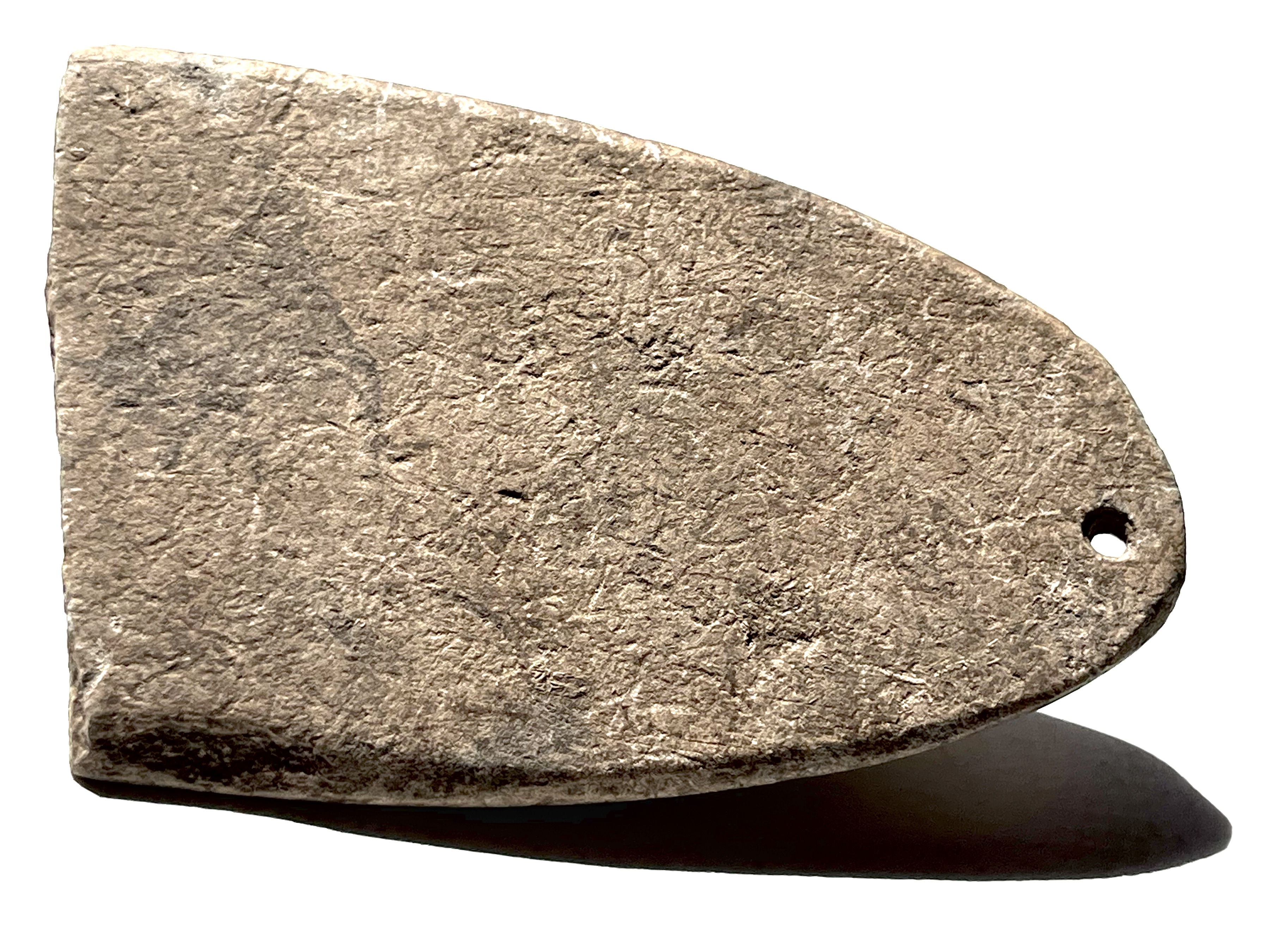
But we also found a couple pieces of rare Archaic art: a small copper artifact (perhaps a pendant to be worn?) about the size of a playing card; and one half of a ground stone, remarkably thin and smooth, and with a biconically-drilled hole in one end, presumably for helping someone wear the piece as a "gorget."


Side (a) of the fractured Stone Gorget

Side (b) of the Stone Gorget

We sent off a tiny sample of the copper artifact to experts in New Jersey and Chicago for analysis. By using inductively coupled plasma mass spectrometry, one can tease out some of the elements associated with the copper. When proportions of those elements (like silver, zinc, antimony, or arsenic) are measured, then you have something resembling a "fingerprint" that can be matched with native copper sources around the continent. This copper artifact's source is likely some place in the Great Lakes area, 1100 or 1200 miles away. If this proves to be the case, it would make this copper artifact the farthest-travelled copper artifact in North America. 

Then we had to begin the process of finding a date for the copper artifact (now we are referring to it as a copper pendant). A few feet away from where we found the copper, we uncovered what looks to be the jawbone of deer. So we sent it away to Washington state to be analyzed using carbon-14 dating technology. Turns out that the deer belonging to this mandible probably lived between 1686 BC and 1520 BC (about the time of Abraham or Moses in another part of the world). And the bone was recovered in a layer of soil 9 cm above the copper, making the copper presumably older than the dates for the deer. So maybe 2000-1600 BC? If this turns out to be the case, it would make it the oldest copper artifact ever found in Texas.

But we have a ways to go before we can make such claims with confidence.

The mandible of a deer (?) which we had carbon-14 dated to 1686-1520 BC.


A profile view of the midden within the cutbank of Hamilton Creek.


The unidentified dart point (likely to be Late Archaic) has been fractured in the heat of fire. Small pieces of the chert pop off, leaving the divots easily seen here below.
A dart point showing "potlidding" likely caused
by fires associated with the midden.


15 1x1 meter contiguous units at the Creek Cabin site.
The screens for sifting through soil are under the gray sun canopy.


An otolith, presumably from a freshwater drum.

Freshwater Drum (Aplodinotus grunniens) I caught a
quarter mile upstream from the archeological dig.
Aplodinotus grunniens
with a bit of butter, salt, and pepper 
one hour after it hung from that hook.


Along with the archeology, we've been locating, gathering, and eating as much local food as we can. 

Piquin chili pepper (Capsicum annuum)


"The pepper—which was declared the official state native pepper in 1997 by then-Governor George W. Bush—grows wild throughout the South Texas brushland... No bigger than the tip of a pinky finger, the pequin can pack a mean punch, clocking in at 50,000 to 100,000 Scoville Heat Units—up to 10 times hotter than the jalapeño. Some may know it as the pequin, chile tepin, chile petín, bird pepper, bird’s eye pepper, or even the chiltecpin (a name used by Nahuas, descendants of the Aztecs, that means “flea pepper”)" (Texas Highways).

We've been taking to making salsa from the piquin: 
  1. Simmer for a few minutes a pound of tomatillo.
  2. Take 30 piquin peppers and two garlic cloves, and toss them around in a hot skillet for a few minutes.
  3. Pour the tomatillo, piquin, garlic, and a bit of salt into a blender, and have at it.
This makes some of the most delicious salsa we've had yet.

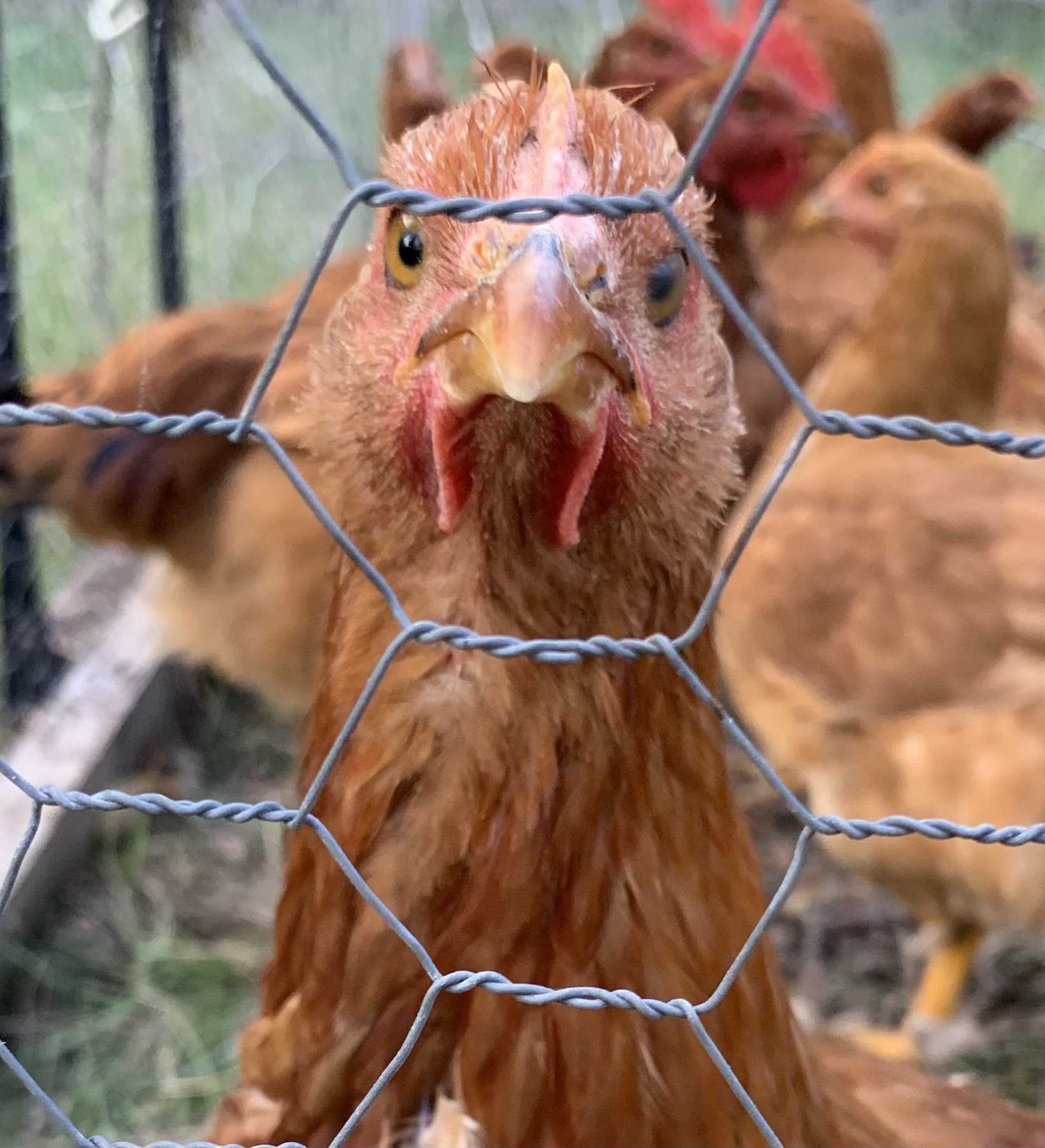
Especially good with homegrown yardbird. Obviously not wild food that Texas Indians might have enjoyed; nonetheless, we've found that raising about 30 birds a year is a good idea. 


Chicken, mustard greens,
and sourdough bread


Plum harvest (to be made into 40 jars of syrup).


Potato harvest kept in a cool, dark closet under the stairs.


Cute (harvest in a year).


Dead juvenile beaver found near the Creek.


As I was typing this blogpost, the poor cicada flew into the window,
succumbing to a fatal case of traumatic brain injury.


By far, the best book we've ever read
on the philosophical subject of death.


Archeology Site


A young couple sat laughing in a springtime evening—

sipping drinks at the end of the BBQ—

she, now sharing the latest talk in astronomy—

he, telling of his trip— 

the lovely places he stayed along the way—

the necklace he bought her.

And their children chasing fireflies

with the neighbors’ kids in the yard.


(insert here a separation of 3640 years +/- 50)


Two men (or perhaps two women) on the ground—

hunched over in the hot sun—

sweat and and dirt-smeared faces—

scraping away with simple tools.


A hole in the ground, perhaps a cooking hearth—

finding burnt bones and a “copper pendant: 

likely of ceremonial use for a sacred ritual.”


One of the archeologists stands up, looks around,

and scratches his backside.